Most of us have moles, and most moles are harmless. What matters is noticing mole changes early, because a spot that grows, darkens or starts to bleed is worth showing a doctor. Australia has one of the highest rates of skin cancer in the world, and Cancer Council says you will have a better outcome if a skin cancer is found and treated early. This guide explains what a normal mole looks like, the changes Cancer Council Australia says to watch for, how to check your own skin, and when to book a skin check at Harpley Doctors in Werribee.
Key Takeaways
- About 2 in 3 Australians will be diagnosed with some form of skin cancer before the age of 70.
- See your doctor about a new spot, or a mole that changes in size, shape or colour.
- The ABCDE guide can help you spot moles that need a closer look.
- Check your whole body in good light, using a mirror or a helper for hard-to-see areas.
What a normal mole looks like
Almost everyone has moles. Cancer Council Australia explains that moles are not normally present at birth but appear in childhood and the early teenage years, and that by age 15 Australian children have an average of more than 50 moles. Normal moles are usually 1 mm to 10 mm across, even in colour and uniform in shape, and they may be raised.
Normal moles also tend to look alike. That is why a spot that looks different from your other moles deserves attention. The more moles or freckles you have, the higher your risk of skin cancer, so getting to know your own skin is especially useful if you have a lot of them.
Mole changes to watch for
Cancer Council Australia’s guide to checking for signs of skin cancer lists these mole changes to look out for:
- new moles
- moles that increase in size
- a mole outline that becomes notched
- a spot that changes colour from brown to black, or becomes varied in colour
- a spot that becomes raised or develops a lump within it
- a mole surface that becomes rough, scaly or ulcerated
- moles that itch or tingle
- moles that bleed or weep
- spots that look different from the others.
Cancer Council also advises seeing your doctor if a mole looks different, or if a new mole appears after the age of 25. Noticing a change does not necessarily mean you have skin cancer, but it is important to have it looked at.
The ABCDE guide
The ABCDE guide is a simple way to remember what to look for when checking for melanoma:
- A is for asymmetry: the two halves of the spot do not match.
- B is for border: the edge is spreading, irregular or notched.
- C is for colour: the spot is blotchy, with several colours such as black, blue, red, white or grey.
- D is for diameter: the spot is getting bigger.
- E is for evolving: the spot is changing and growing.
Not every skin cancer fits this pattern. Cancer Council notes that nodular melanoma grows quickly and looks different from common melanomas. It is raised and even in colour, often red or pink but sometimes brown or black, firm to touch and dome-shaped, and it may bleed and crust after a while. Skin cancers rarely hurt, and they are much more often seen than felt.
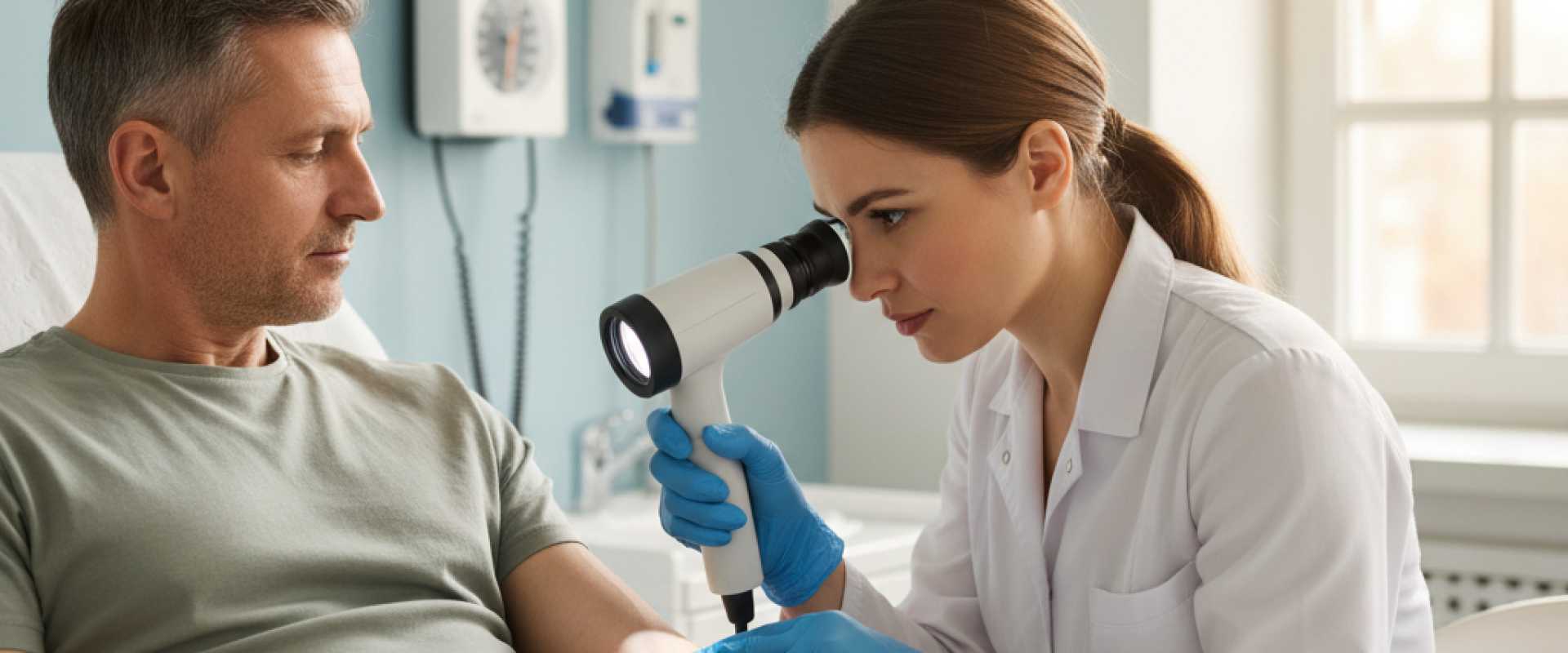
Found a mole that has changed or looks different from the rest? Book an appointment with one of our GPs to have it checked, seven days a week in Harpley Town Centre.
How to check your own skin
Undress completely and check in a room with good light. Use a full-length mirror for your whole body, and a hand mirror or a partner, friend or family member for hard-to-see areas such as your back and scalp. Skin cancers can also appear on skin that is not usually exposed to the sun, so include the soles of your feet, between your fingers and toes, and under your nails.
Cancer Council suggests making a regular time for a skin self-check, such as a calendar reminder for the first day of each month or a check at each change of season. Research shows smartphone apps cannot reliably detect skin cancer, so if a spot worries you, see your doctor rather than relying on an app. Our article on preventive health checks at every stage of life explains how checks like this fit into looking after your health, and our medical check-ups are a good time to mention any spot you are unsure about.
Who should be extra careful
Anyone can develop skin cancer, and Cancer Council’s skin cancer risk factors page notes that about 2 in 3 Australians are diagnosed with some form of it before 70. Your risk is higher if you have pale or freckled skin that burns easily, red or fair hair and light-coloured eyes, lots of moles, a previous skin cancer or a family history of it, a weakened immune system, or a history of sunburn, tanning, solarium use or outdoor work. If that sounds like you, ask your GP how often you should have your skin examined. Workers spending long days outside can also raise it during an occupational health appointment.
Getting a mole checked at Harpley Doctors
Harpley Doctors offers minor skin procedures and full-body skin checks in Werribee. Dr Reda Aboelsaad’s interests include skin lesion removal and minor surgical procedures, and Dr Khalida Batool’s include dermatology and minor procedures such as cyst removal and cryotherapy. You can read more on our team page and about our small-scale surgeries.
All consultations and procedures are bulk billed. More detail is on our patient information and fees page.
The clinic is open seven days at T20, 1 Hindson Street, Werribee, including weekends and extended hours. You can book online through HealthEngine or call (03) 8731 1330. If you have noticed mole changes, there is no need to wait for a routine check to have them looked at.
Frequently Asked Questions
Does a changing mole mean I have skin cancer?
Not necessarily. Cancer Council Australia says a skin change does not always mean cancer, but it is important to see your GP so it can be investigated.
Is a new mole in adulthood a concern?
Cancer Council advises seeing your doctor if a new mole appears after the age of 25, or if a mole looks different from your others.
How much does a skin check cost at Harpley Doctors?
Skin checks are bulk billed, like all consultations and procedures at Harpley Doctors.
How can I protect my skin from new damage?
Use sun protection whenever the UV Index is 3 or above, as set out in Cancer Council’s Be SunSmart advice.
A quick look today can put your mind at ease. Book a mole or skin check with Harpley Doctors, online through HealthEngine or by phone.